
| More Heads | The Body | From the Rear | Movement | Standards | Anatomy | Famous Sires | Photo Gallery | Links |
| Differences Around the World | Body Style Comparisions | Beautiful Heads | Eye Shape | The Skull Shape | Optical Illusions |
| How Structure affects Movement | Choosing a Puppy | Contact Me |
THE SIDE VIEW
Click here to view BODY STYLE COMPARISONS page
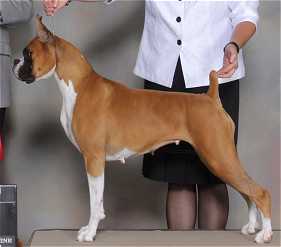
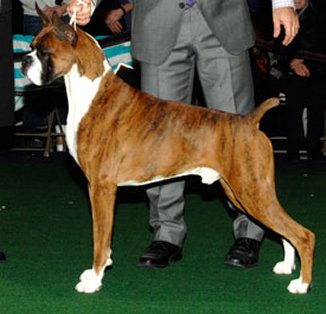
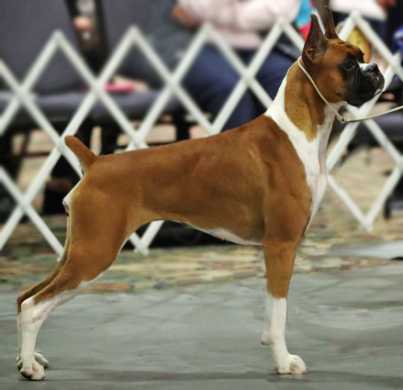 A well balanced mature Boxer of today |
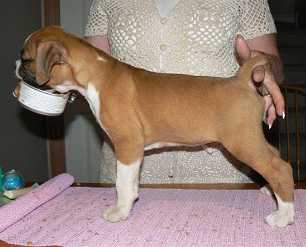
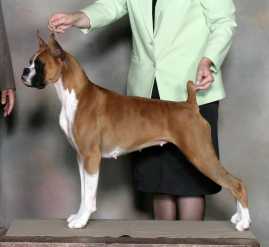
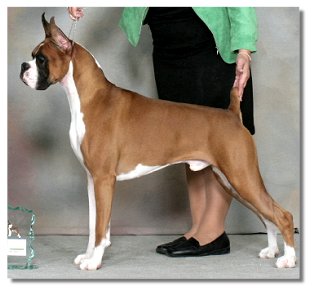
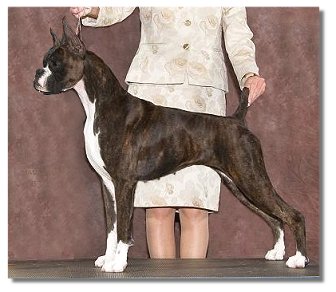
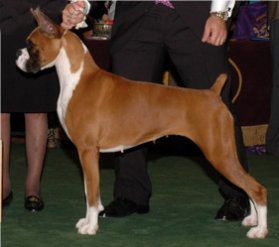
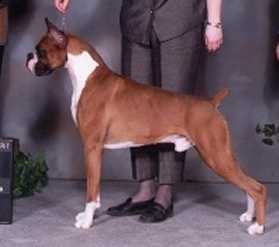
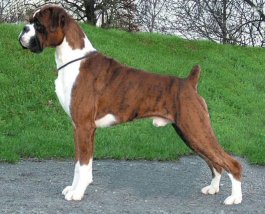
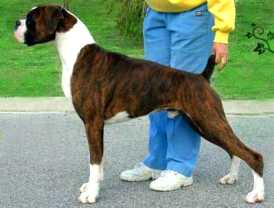
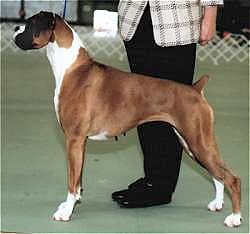
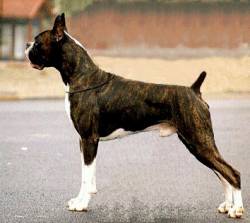
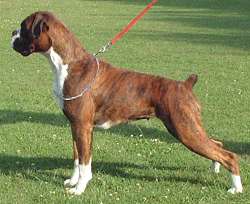
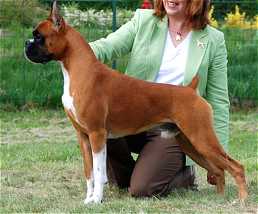
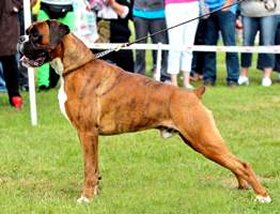
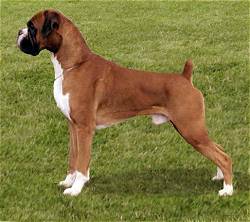
Appraising the side view from a distance of at least 10 feet, check that the balance is correct.
- Is the head too big or too small for his body?
- Is the neck of good length and set correctly into his shoulders? It should not be abrupt.
- Is the back short with a straight (but not level) topline? No dipping, sagging, or roaching.
- Does the topline slope gently from withers to root of tail?
- Do the forequarters balance with the hindquarters? Well anglulated, front and rear?
- Is the depth of chest equal to the length of foreleg? Does it reach to the elbows?
- Is the tail set on correctly? Not too high or too low? (5 minutes after 1 o'clock is perfect!)...(see NOTE below)
- Is there dog behind the tail? (A Boxer should have a nicely rounded rump, not chopped off.)
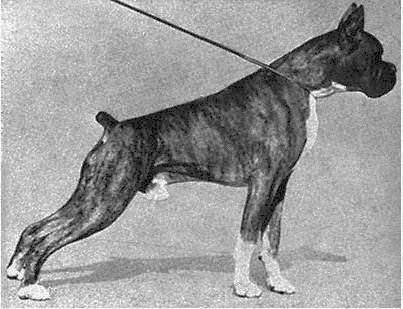
A German Champion born 1961
Young Puppies
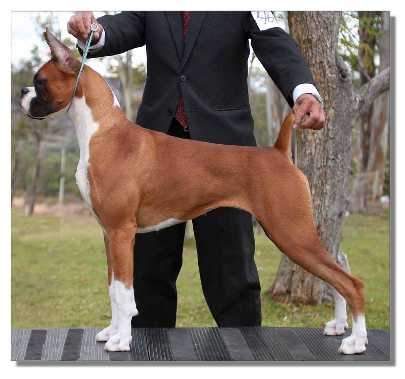
A beautifully balanced young puppy bitch at 7 months of age
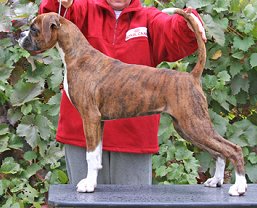 A well balanced 5 month old puppy |
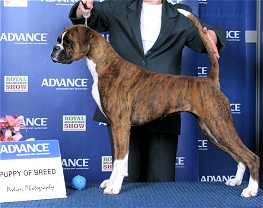 Same puppy at 10 months |
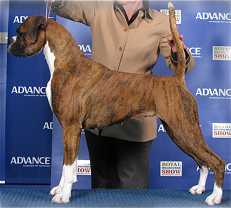 Same Female as an adult |
NOTE: As mentioned above, the set on of the tail is at 5 minutes past 1 and as many countries have now made docking of tails illegal, it is much more important to look at the set of the tail rather than how it is carried! If it is set on correctly, and the dog has the correct temperament, the undocked tail will be carried high on the move and may drop when relaxed. Disregard the length of the tail, the amount of curve to the tail or if it is carried to the left or right on the move.
 |
 |
 |
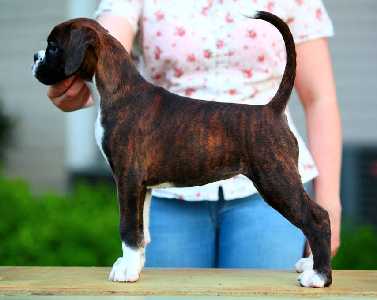
A well contructed bitch at 5 weeks, 1 year and 4.5 years
 |
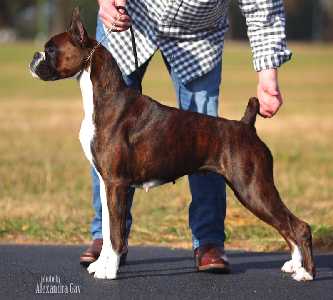 |
A lovely bitch at 8 weeks and 21 months.
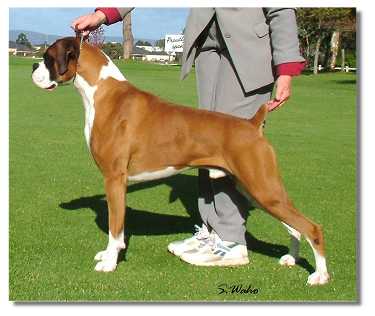
Mature Boxers
 |
 |
 |
 |
 |
 |
 |
 |
 |
 |
 |
 |
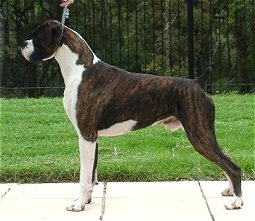
 |
 |
CLICK TO VIEW THE DIFFERENCE
THAT CROPPING MAKES TO A DOG

A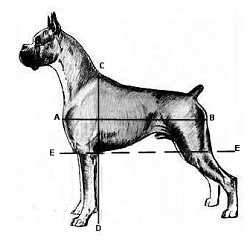 |
B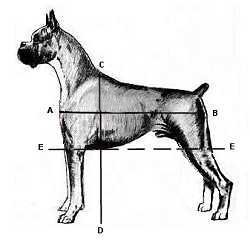 |
Look closely at the two dogs above. Which do you think is the squarer dog?
Actually they both measure square. The line A and B and C and D are all of equal length in both dogs.
Now look at the length of back between C and the set-on of tail on the two dogs.
Can you see the difference? B is longer in back, measured between these two points. Get out your slide rule if you don't believe me.
B looks balanced, because his incorrect straighter front angulation matches his straighter rear angulation. Look closely where his front feet are. They are more forward under his neck, and there is no forechest evident. He has a flat front. More than likely when viewed from the front, he would have a lack of fill between his front legs. (Cathedral fronted)
Now look at the rear of the two dogs. The B's tail is correctly set, but he drops off sharply behind the tail, whereas A has a decided curve to his rump.
Another very important measurement is C to E (Depth of Chest) and E to D (Length of Leg). For a Boxer to have correct balance, this measurement must be equal! Both are correct here.
A's correct angulation enables him to have a longer stride, move more smoothly and cover more ground. B would need more steps to cover the same amount of ground.
Click here to view BODY STYLE COMPARISONS page
| More Heads | The Body | From the Rear | Movement | Standards | Anatomy | Famous Sires | Photo Gallery | Links |
| Differences Around the World | Body Style Comparisions | Beautiful Heads | Eye Shape | The Skull Shape | Optical Illusions |
| How Structure affects Movement | Choosing a Puppy | Contact Me |
Copyright © Worldwide Boxer - All rights Reserved
Site design by Webpage World